
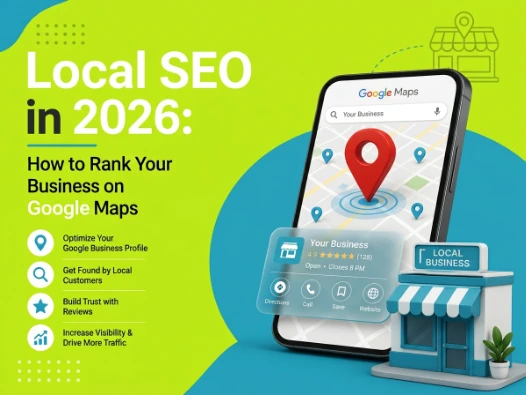
If your business in Richmond, Ashburn, or Alexandria isn’t showing up in local searches, you’re missing customers and probably losing revenue every day. This guide is for service-area businesses, shop owners, and marketing managers in Virginia who want actionable, real-world steps to dominate Google Maps in 2026.
You’ll learn how to optimize your Google Business Profile, collect reviews that actually move the needle, create hyper-local authority, and leverage AI signals that most competitors still ignore. These aren’t just theories; these are strategies we’ve tested with Virginia clients, producing measurable results fast.
What is Google Maps SEO and the Local 3-Pack?
Ever searched “best pizza near me” in Alexandria and noticed the three local businesses with star ratings, addresses, and reviews at the top? That’s the Local 3-Pack, and it’s prime real estate for any business. Google Maps SEO is all about making your business irresistible to Google and AI-driven search models, so your business gets seen by the people nearby who are ready to buy.
How Google determines local ranking
Google mainly considers three factors when ranking businesses in the Local 3-Pack:
- Relevance: Does your profile match the search? Use precise categories, service descriptions, and keywords. For example, a local SEO agency should list “Local SEO services in Richmond” rather than just “SEO services.”
- Proximity: How close you are to the searcher matters. Hyper-local optimization, like targeting ZIP codes 20147 or 22314, can make a huge difference.
- Prominence: How reputable your business is online. This includes reviews, backlinks, citations, and AI signals like structured data. In our experience, a business with 50 detailed reviews mentioning exact services consistently outranks one with a perfect 5-star score but only 10 reviews.
Google also looks at engagement: clicks, calls, and direction requests, and now AI analyzes reviews and posts to understand exactly what your business provides.
Why appearing in the Local 3-Pack matters
The top three Local Pack listings get 70–80% of clicks. For Virginia businesses, this means more foot traffic, calls, and booked services. Being in the 3-Pack is like having a digital storefront on the busiest street in your city. Don’t settle for being invisible while your competitors grab those clicks.
Setting Up Your Google Business Profile for Maximum Visibility
Your Google Business Profile (GBP) is the foundation of local SEO. If it’s incomplete or inaccurate, no amount of website SEO will get you into the Local 3-Pack. Optimizing it properly ensures Google and AI-driven search engines can understand exactly what your business offers and where you operate.
Claiming and verifying your profile
Before you can optimize, you need control of your profile. Go to Google Business Profile and either:
- Claim an unverified profile: Search for your business, click “Claim this business,” and follow verification steps (mail, phone, or email).
- Verify an existing profile managed by someone else: Request ownership through Google and complete the verification process.
Verification signals to Google that you’re a legitimate business and unlock all optimization features.
Filling out every field correctly
Every section of your profile matters. Fill out:
- Business name exactly as used in signage
- Address (use your local Virginia location)
- Phone number consistent across all listings
- Business hours, special hours, and holiday schedules
- Website URL
- Attributes (e.g., “Women-led,” “Wheelchair accessible”)
Complete, consistent data increases your prominence and ensures AI-driven search engines trust your listing.
Selecting categories that AI loves
Categories tell Google what your business really does. Pick your primary category carefully (e.g., “Plumber” or “Coffee Shop”) and add secondary categories to capture niche services. AI now uses these categories to match queries even when they don’t exactly match your wording, so accurate selection can trigger your profile in more relevant searches.
Adding service areas and geo-coordinates
For service-area businesses (like home services or delivery), define service areas in GBP to signal where you operate. Include cities, neighborhoods, or ZIP codes in Virginia. You can also use geo-coordinates for precise mapping, helping Google understand exactly where your business is located. This is particularly useful for local AI ranking signals, which increasingly weigh proximity and hyper-local relevance.
Optimizing for Reviews, Ratings, and AI Signals
Reviews aren’t just about bragging rights; they’re one of the most powerful signals Google uses to rank businesses in the Local 3-Pack. In 2026, AI also scans review content to infer what your business provides and how reliable it is, making strategy and phrasing more important than ever.
How to trigger “provides” and “sold here” snippets
AI-driven search engines now extract service and product information directly from your reviews and profile. To trigger “provides” or “sold here” snippets:
- Encourage customers to mention the exact service or product they used (e.g., “I hired Virginia SEO Company for local SEO and saw great results”).
- Include relevant keywords naturally in your GBP description and posts.
- Use structured Q&A sections to specify services offered in each location.
When done correctly, Google may display these as rich snippets in the Local Pack, boosting visibility and credibility.
Review acquisition strategies that actually work
Getting more reviews isn’t about spamming your customers; it’s about timing and convenience:
- Ask at peak satisfaction moments: After completing a service or delivering a product.
- Use multiple channels: Email follow-ups, SMS, receipts with review links, or QR codes in your store.
- Make it easy: Direct links to your GBP review form remove friction.
- Incentivize ethically: Offer general discounts or loyalty points, not rewards for positive reviews, to stay compliant with Google policies.
- Focus on specific, detailed reviews rather than just star ratings; these help AI understand your services better.
Responding to reviews to influence AI and Local Pack rankings
Replying to reviews does more than show good customer service; it signals engagement and relevance to AI models:
- Respond promptly, addressing both positive and negative feedback.
- Include service-specific keywords naturally, e.g., “Thanks for using our local SEO services in Richmond!”
- Show empathy and solutions for negative reviews. Google AI recognizes this as credibility and trustworthiness.
- Track patterns in feedback to improve services and optimize your GBP further.
Consistent, strategic engagement with reviews can increase the likelihood of appearing in AI-enhanced Local Packs while building stronger local authority.
Website & On-Page SEO Integration
Your Google Business Profile is powerful, but pairing it with a well-optimized website multiplies results. Local SEO isn’t just about showing up on Maps; it’s about making your website a clear, location-aware signal for Google and AI-driven search engines. For Virginia businesses, this means demonstrating exactly where you operate and what services you offer in each city or neighborhood.
Embedding Google Maps and NAP consistency
Embedding a Google Map on your contact or landing pages does more than help users—it reinforces location signals to Google. Make sure your NAP (Name, Address, Phone) is identical everywhere:
- Google Business Profile
- Website footer or contact page
- Local directories like Virginia.org, Northern Virginia Chamber of Commerce, or Richmond Chamber of Commerce
In our experience, businesses that maintain perfect NAP consistency rarely see drops in Local 3-Pack rankings. Even a small discrepancy in phone numbers or ZIP codes can confuse AI-driven models and cause ranking fluctuations.
Localized landing pages for service areas
If you serve multiple Virginia cities, create dedicated landing pages for each location. This signals to Google exactly which services you provide where:
- Include the city name naturally in headings, title tags, and meta descriptions
- Highlight services specific to that area
- Link each page back to your main location page to consolidate authority
For example, a local SEO agency might have pages for Richmond SEO services, Alexandria local SEO, and Norfolk SEO consulting. Google and AI models can clearly map your footprint, improving Local Pack visibility across the state.
Schema markup
Structured data is your secret weapon. It helps Google understand your business at a glance and increases the chances of appearing in AI-enhanced Local Packs.
Mobile-first optimization and page speed
Most local searches happen on mobile devices, so Google prioritizes mobile-first sites. A slow or unresponsive site can kill your rankings even if your GBP is perfect.
Here’s what works best:
- Use responsive design for all landing pages
- Compress images without sacrificing quality (tools like TinyPNG or ImageOptim help)
- Minimize JavaScript and CSS to reduce page load times
- Enable lazy loading for heavy media or photo galleries
In our experience, Virginia businesses that get mobile page speed above 90/100 on Google PageSpeed Insights see measurable gains in clicks and Local Pack visibility. It’s one of the fastest wins you can implement.
Building Hyper-Local Authority
Ranking high on Google Maps isn’t just about your profile and website; it’s about showing Google you’re an active, trusted part of your local community. Hyper-local signals help your business stand out in competitive Virginia markets.
Linking to local entities and news sources
Partnering with or referencing trusted local sources signals authority to Google:
- Link to local newspapers, business directories, or community organizations from your website or blog posts.
- Get backlinks from these local sites whenever possible.
- Mention collaborations or partnerships on your GBP posts or social media.
For example, a Richmond-based marketing agency could reference or link to city-specific tech events or local business associations. These links reinforce your geographic relevance to AI-driven search engines.
Sponsoring events and engaging community content
Google recognizes businesses that are active offline as well:
- Sponsor local events, charity drives, or workshops and mention them online.
- Post photos or updates on your GBP showing community involvement.
- Highlight local initiatives in blog posts or newsletters.
This not only builds trust with customers but also boosts prominence signals that influence Local 3-Pack rankings.
Internal linking strategies to signal local relevance
Your website structure can reinforce locality:
- Create internal links from neighborhood or service area pages to your main location page.
- Include anchor text with local keywords naturally (e.g., “SEO services in Alexandria”).
- Maintain a logical hierarchy: city pages → service pages → blog posts about local events or case studies.
Proper internal linking ensures Google understands your business’s local footprint and improves the chances of appearing in AI-optimized map results.
Tracking, Analytics, and Continuous Optimization
Local SEO isn’t a set-it-and-forget-it process. To stay visible in the Local 3-Pack, you need to track performance, monitor signals, and adjust your strategy based on real-world data and AI insights.
Using Google Search Console and Local Falcon
- Google Search Console helps you see which search queries bring traffic to your site, how your pages rank, and which keywords need improvement. For local businesses, pay attention to location-based queries and click-through rates.
- Local Falcon provides a visual heatmap of your Google Maps rankings across different neighborhoods. This shows where your business ranks well and highlights areas where optimization is needed.
By combining these tools, you can identify strengths and weaknesses in your local SEO strategy.
Monitoring rankings and citations
- Track your Local 3-Pack rankings regularly, focusing on target cities or ZIP codes in Virginia.
- Audit citations to ensure NAP consistency across directories, social profiles, and review sites.
- Monitor review activity and engagement metrics. AI increasingly weighs these signals for Local Pack visibility.
Regular audits help prevent ranking drops caused by outdated information or inconsistent listings.
Adjusting strategy based on AI-generated insights
Modern AI-driven search models look at structured data, reviews, and content relevance. To stay competitive:
- Update GBP attributes and services as you add new offerings.
- Adjust content on localized landing pages based on which queries are generating traffic.
- Experiment with review phrasing, posting schedules, and local link-building tactics.
Continuous optimization ensures your business stays visible to both humans and AI, keeping your Local 3-Pack presence strong.
Common Google Maps SEO Mistakes to Avoid
Even small missteps can keep your business out of the Local 3-Pack. Avoid these common mistakes that many Virginia businesses make:
- Duplicate listings, multiple profiles for the same business, confuse Google and dilute your ranking. Merge or remove duplicates promptly.
- Incomplete profiles: Leaving fields blank, skipping hours, or not adding a website reduces your relevance and trust signals.
- Ignoring reviews, failing to collect or respond to reviews, hurts prominence and can lower your Local Pack ranking.
- Outdated photos, old or low-quality images, make your profile less appealing to users and AI alike. Keep visuals fresh and professional.
- Poor local signals, inconsistent NAP, missing citations, and a lack of community engagement signal a weak local authority to Google.
By proactively fixing these issues, you maintain a strong foundation for Google Maps SEO and ensure your business stays competitive in your local market.
Checklist for Virginia Businesses
Want to see results fast? Here’s a practical, sidebar-style checklist that Virginia business owners can implement today to boost Google Maps rankings:
- Verify your profile Make sure your Google Business Profile is claimed and fully verified.
- Fill categories + service areas Choose accurate primary and secondary categories, and define your service areas in Virginia cities or neighborhoods.
- Add 10+ high-quality photos Showcase your business, team, products, and services. Quality visuals increase engagement and trust.
- Request 5+ recent reviews Encourage satisfied customers to leave detailed reviews mentioning your services and location.
- Embed maps on your website Reinforce location signals and help visitors find you quickly.
- Apply Local Schema markup. Add structured data to your site so Google and AI-driven search engines clearly understand your business details.
These steps are simple but powerful. They cover the foundational elements Google looks for in Local Pack rankings while giving your Virginia business a competitive edge.
Conclusion
Ranking higher on Google Maps isn’t magic; it’s the result of consistent, strategic action. From claiming and optimizing your Google Business Profile, gathering reviews, and embedding maps on your website, to building hyper-local authority and monitoring AI-driven signals, every step plays a role in securing a spot in the Local 3-Pack.Start implementing these strategies today. Even small improvements like updating your profile, posting high-quality photos, or responding to reviews can yield noticeable results. Start optimizing your Google Business Profile today with Virginia-specific strategies and gain an edge in 2026
